
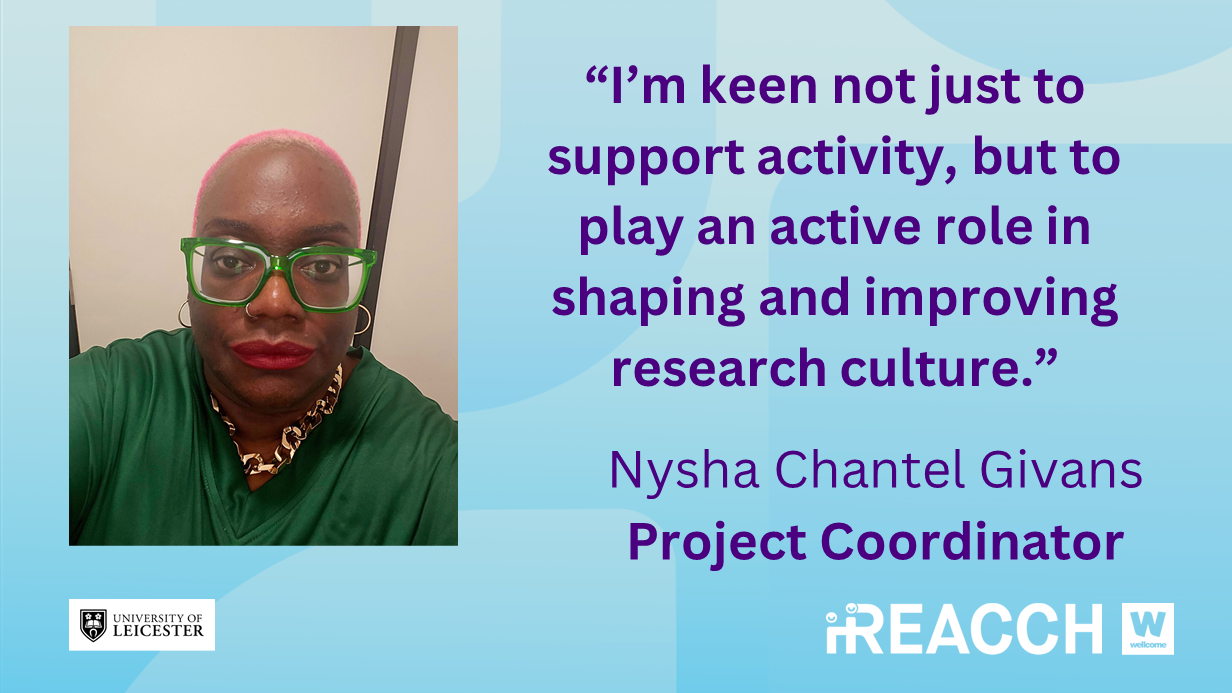
Meet Nysha Givans, The I-REACCH Project Coordinator!
As the Project Coordinator, I support the I-REACCH team across communications, admin, and events. Most prominently, I am the person behind all the social media, webpages, email digests, and newsletters (including wherever you are reading this from!).
There’s great satisfaction in having access to these “front line” forms of communication, because I can directly see the results of our efforts. Whenever I see engagement—whether that’s a comment, an email enquiry, or a sign-up—I know that we are reaching the research community and that people are interested. It’s especially rewarding to see that engagement grow, showing how the seeds we plant through our work can contribute to strengthening research culture over time.
Through my involvement in this project, I’m keen not just to support activity, but to play an active role in shaping and improving research culture. A key part of this for me is learning from the researchers we work with—understanding their perspectives, experiences, and the challenges they face—so that we can reflect these insights in how we communicate, engage, and support meaningful change.
Conversations about research culture are already happening within the sector, and we aim not to reinvent the wheel, but to support and amplify existing activity within (and beyond) the university. For example, we’ve successfully funded 15 smaller-scale research culture projects, and we continue to support them through logistics while promoting their work through our communications. Engaging with these projects also gives me valuable opportunities to learn directly from researchers and the innovative approaches they are taking.
It has been a learning curve to understand how we can reach different groups to maximise impact and engagement. There is so much happening—we just need to find ways to connect people with it. As part of I-REACCH, we are exploring how to engage both those already eager to collaborate and the “hardest to reach” groups within the university. In doing so, I hope that our work not only builds stronger connections across research environments, but also enables us to learn from those communities and contribute to a more inclusive and responsive research culture.