
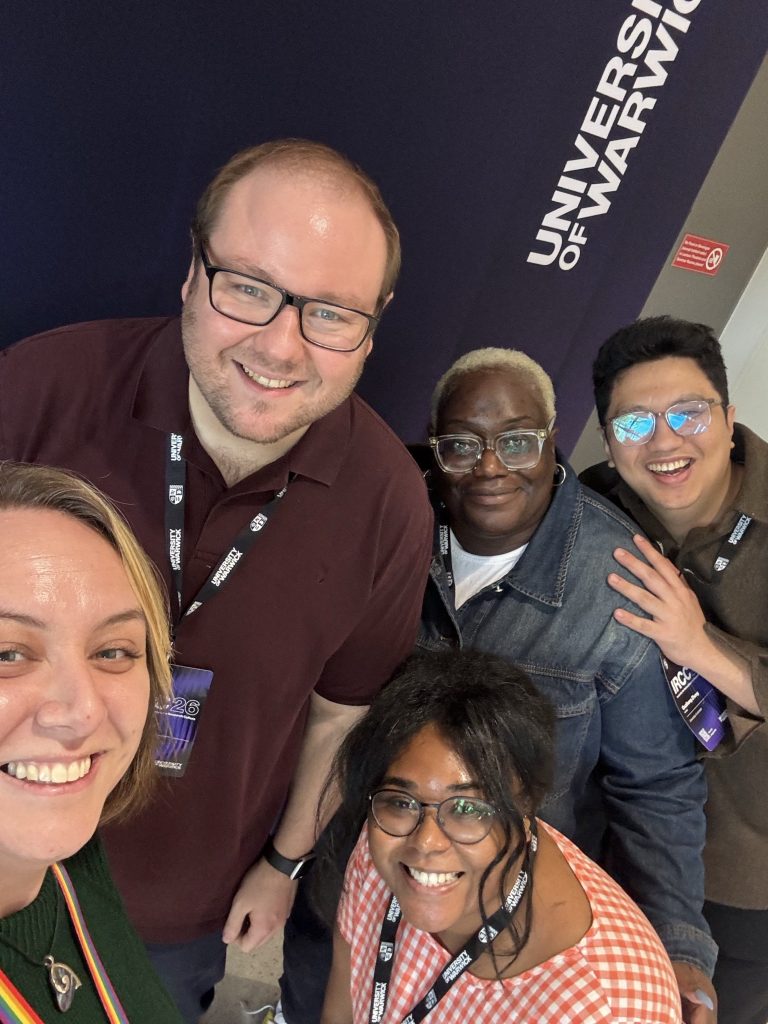
From Individual Responsibility to Collective Accountability: Reflections on IRCC 2026 by Fi Wood
On 21 and 23 September 2026, I attended the International Research Culture Conference 2026, joining the first day online before travelling to the University of Warwick for the in-person programme. This year’s theme, Collaboration for Lasting Change, placed partnership, co-creation and collective action at the centre of the conversation.
Across both days, one message emerged repeatedly: improving research culture is not primarily about helping individuals adapt to difficult systems. It is about redesigning the systems themselves.
Whether discussing funding, inclusion, career development, wellbeing or professional recognition, speakers consistently challenged institutions, funders and sector leaders to move beyond individual responsibility and towards collective accountability.
Changing the Incentives that Shape Research
The opening funders’ panel offered several examples of how funding organisations are trying to influence research culture through the design of their schemes.
Dr Sean Sapcariu (Luxembourg National Research Fund) discussed narrative CVs, recognition of research mentorship and dedicated funding for activities such as training, EDI and HR support. Geraldine Clement-Stoneham (Medical Research Council UK) outlined the development of Centres of Research Excellence, including Research Culture Leads embedded within leadership teams.
From the British Academy, Dr Ken Emond shared learning from a pilot involving partial randomisation in funding allocation, while Dr Charlotte Spear (Wellcome Trust) described how research culture and equity are increasingly being embedded within funding expectations and review processes.
What struck me most was that none of these initiatives were presented as standalone solutions. Instead, they reflected a broader recognition that culture is shaped by systems, incentives and behaviours, and therefore requires coordinated action rather than isolated interventions.
Inclusion Requires More Than Good Intentions
Several sessions focused on the gap between institutional aspirations and lived experiences.
Dr Stewart Eyres (Eyres Inclusion Consulting) and Dr Cristina Izura (Swansea University) explored whether inclusive research environments are sufficient to support diverse doctoral researchers to progress and thrive within academia. Their work raised important questions about whether traditional measures of success and progression continue to disadvantage some groups, even within institutions committed to inclusion.
Similarly, the Women in Academia Project, presented by Dr Talar Moukhtarian and Dr Marie Sams from the University of Warwick, highlighted the importance of addressing structural barriers rather than focusing solely on helping individual women navigate existing systems.
Job precarity, uneven workloads and persistent gendered expectations appeared as interconnected challenges that require systemic responses.
This resonated strongly with themes I’ve encountered through I-REACCH. Many research culture challenges are experienced individually, but they are often rooted in wider structures, processes and incentives. Listening to lived experience is essential, but lasting change depends on addressing the factors that repeatedly create those experiences.
It was also great to see Aaron Andrews highlight the University of Leicester’s I-REACCH project within the wider programme, demonstrating how institutional initiatives can contribute to broader sector conversations about culture change.
Collecting Evidence is Not the Same as Using It
One of the most thought-provoking presentations came from Professor Jayne Hope, Dorotea Deshishku, Jeanette King and Dr Sam Gamal at the Roslin Institute, University of Edinburgh.
Their work examined EDI metrics across eight BBSRC Strategically Supported Institutes and found substantial variation in how information is collected, defined and reported.
Perhaps the most striking finding was not about gaps in data collection, but about evaluation. Very few institutions could show how evidence had been used to inform the development of EDI-related policies and interventions.
As research culture practitioners, we often emphasise the importance of evidence. This session provided a useful reminder that collecting data is only the first step. The real value comes from acting on what it tells us.
Belonging, Failure and the Human Side of Research
Some of the most impactful discussions focused on experiences that remain common across research environments but are often discussed less openly.
Anna Butters, Ke Li and colleagues from the University of Sheffield presented Space to Belong, exploring how belonging influences postgraduate researcher wellbeing. Their work highlighted the importance of supportive physical and social environments, particularly for international researchers and those navigating complex supervisory relationships.
Equally memorable was research led by Dr Celia Bernstein and colleagues at the University of Warwick, examining experiences of failure within academia. While failure is an inevitable part of research, it is often internalised as personal inadequacy. The project highlighted how much existing support focuses on helping individuals become more resilient, rather than addressing the stigma attached to failure itself.
Across both sessions, the underlying message was clear: wellbeing and belonging cannot be separated from broader research culture discussions.
Career Development is a Culture Issue
A presentation from Emma Ruby Francis, Lucy Dang and colleagues at University College London particularly resonated with my work on the I-REACCH Career Atlas.
Using behavioural science approaches, the team explored what influences people’s motivation, capability and opportunity to engage with career development. Their response included a range of communication and engagement activities designed to raise awareness, build confidence and improve access to support.
What I found especially interesting was the recognition that resources alone are not enough. People need to know support exists, understand its relevance and feel empowered to engage with it.
This reflects a challenge we often meet in career development work. The availability of support is important, but culture often determines whether people feel able to use it.
Beyond Partnership: Towards Collective Impact
The keynote from Professor Jimmy Volmink, Executive Director for Equity at Wellcome, provided one of the strongest frameworks of the conference. He challenged attendees to move beyond partnership and towards collective impact.
Partnership, he argued, does not automatically create collaboration. Instead, meaningful collaboration requires shared purpose, aligned incentives and collective accountability.
Several ideas from the keynote stayed with me, particularly the need to move:
- From consultation to co-creation
- From individual credit to collective recognition
- From responsibility to accountability
One statement captured the challenge perfectly: Representation is not the same as influence.
Inviting people into discussions is important, but genuine inclusion requires giving people meaningful opportunities to shape decisions and outcomes. As someone involved in co-creation and stakeholder engagement through I-REACCH, I found this distinction particularly powerful.
Supporting Early Career Researchers Through Practical Change
One of the strongest themes throughout the conference was the importance of creating fairer and more transparent pathways for early-career researchers.
Dr Giudita Fontana (University of Birmingham) presented peer-led initiatives including publication development schemes and fellowship cohorts designed to support ECR progression and community building.
Dr Sonja Weirauch (University College London) shared reforms to ECR promotion processes that introduced additional support, multiple application opportunities and panel-based review mechanisms.
Meanwhile, Dr Barbora Oudova-Rivera (University of Warwick) explored postdoctoral experiences of management, highlighting the challenges that arise when researchers are expected to supervise others without receiving adequate management training themselves.
Together, these presentations reflected a shift away from expecting individuals to simply navigate difficult systems and towards redesigning processes to be more transparent, supportive and equitable.
Recognising the Wider Research Community
The final plenary sessions focused on groups that are essential to research but have historically received less visibility.
In a fascinating keynote, Dr Kelly Vere MBE (UK Institute for Technical Skills & Strategy ) discussed the impact of the Technician Commitment, showing how coordinated action can improve recognition, career development and support for technical professionals.
The closing panel introduced the emerging Research Professional Futures initiative, with contributions from Dr Isabella von Holstein (King’s College London), Dr Dan King (Research Consulting) and Dr Jess Pilgrim-Brown (University of Oxford).
Across both sessions, a common question appeared: Who gets recognised as contributing to research?
For me, this was one of the most important discussions of the conference. Research professionals, technicians and many other specialist roles make significant contributions to research but are not always fully recognised within traditional academic structures.
Creating more inclusive research cultures requires us to value the full range of expertise that makes research possible.
Final Thoughts
What struck me most across IRCC 2026 was how many conversations moved beyond asking individuals to become more resilient, adaptable or productive.
Instead, the focus was on changing systems.
Whether discussing funding, inclusion, career progression, management, wellbeing or recognition, the underlying question remained remarkably consistent: How can we build systems that allow more people to succeed?
That feels both encouraging and challenging.
Across the conference, I saw numerous examples of institutions moving beyond identifying problems and beginning to test interventions, evaluate outcomes and share learning with the wider sector. The next challenge is understanding which approaches genuinely improve people’s experiences and ensuring those successes can be sustained.
The conference ended on a particularly positive note when my colleague Dr Cleo White received a poster presentation prize. After two days of discussions centred on collaboration, inclusion and recognition, it felt like a fitting conclusion, and I was incredibly proud to see her work recognised.
My biggest takeaway from IRCC 2026 is that research culture is not something that sits alongside research. It is one of the conditions that determines whether research, and the people who make it possible, can truly thrive.