
Reflections from the Wellcome Institutional Research Culture Community Event 2026
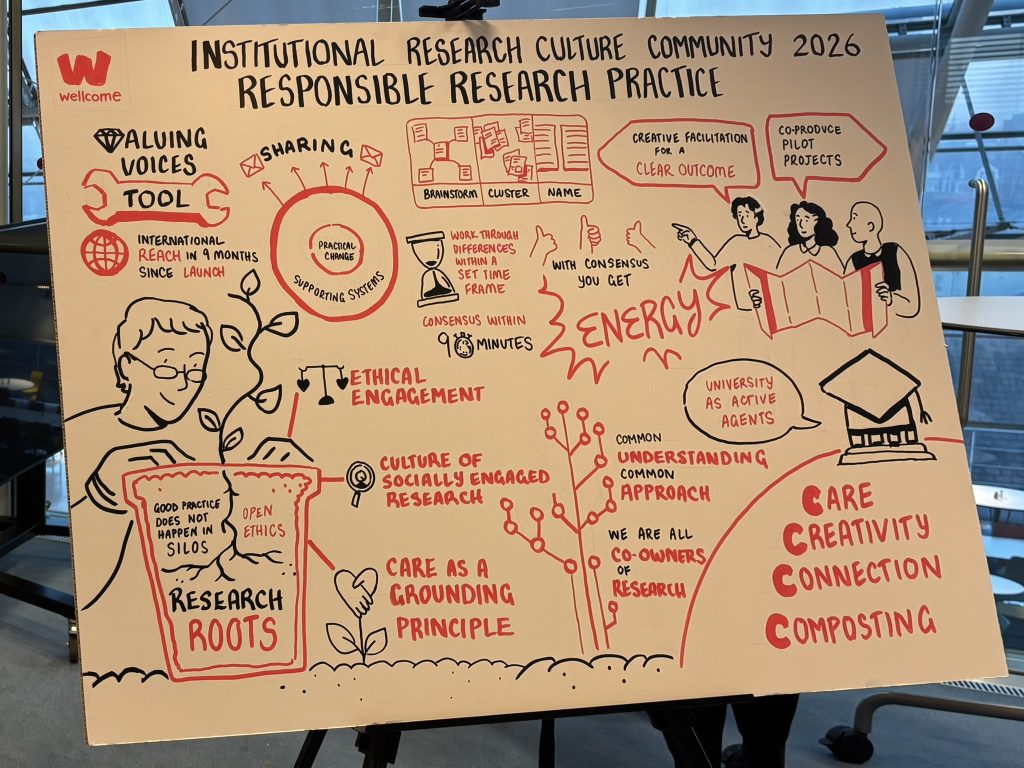
Photo credit: Scriberia
On 18–19 March 2026, I joined colleagues from across the UK at the Wellcome Trust in London for two days of conversations about what healthier, fairer and more sustainable research cultures could look like. The mix of familiar faces and new ideas set the tone for an event that felt energising, honest, and at times, refreshingly challenging. With multiple sessions running at once, I focused on themes that shape my day-to-day work: researcher experience, meaningful development, equity, and the human side of culture change. Here is the journey I followed and what stayed with me.
Day One: Inclusion, Equity and Collaborative Culture
Envisioning Anti‑Ableist Universities
Dan Goodley, Lauren White and the WAARC team set the tone early with a powerful vision for anti‑ableist universities — places built with disabled people, not just “made accessible”. Their emphasis on universal design really stuck a cord. As someone who benefits from adjustable lighting, their message about proactive accessibility felt especially relevant.
Addressing Postgraduate Inequity with ERA
Mohani‑Preet Kaur Dhillon shared the Equal Representation in Academia (ERA) programme, tackling the structural barriers facing prospective PGRs from marginalised backgrounds. Early research exposure, inclusive selection, and supportive networks – simple concepts with a huge impact on confidence and sense of belonging. Sadly, many of the inequalities she described are still common across the sector.
Shaping Culture with Real Voices
From Leicester, Vicki Emms highlighted how lived experience can genuinely shift research culture. Her work with the I‑REACCH Mirror Team was a great reminder that people feel more invested when they have a meaningful say. Sometimes creating space for honest contribution is half the work.
Strategic Funding with Local Flexibility
Genna del Rosa and Roz Stanton from University of Southampton discussed how they balance central strategy with local autonomy – tricky in a devolved institution. I appreciated their honesty about the complexity. Culture work rarely fits tidily into a spreadsheet.
Panel Reflections: Embedding Change
The panel echoed a key theme: people want to engage in culture work when they feel supported and when their time is respected. The candid recognition of mismatch between grassroots lived experience and top-down ambitions was refreshing to hear.
Research Culture in Times of Crisis
In the afternoon, Churnjeet Mahn, Marco Reggiani, Hollie Jackson Ireland and Devon McHugh (University of Strathclyde) led a thoughtful discussion on how crises, whether financial, structural or societal, reveal what institutions truly value. Emotional labour, invisible work and community‑holding often go unacknowledged. The session’s message was clear: values must be lived, not just written. It felt grounding and quietly energising.
Afternoon Lightning Talks: Collaboration and New Approaches
A fast-paced but inspiring set of talks closed Day One:
- National Centre for Research Culture (NCRC) – Vicky Strudwick and Rika Nair showcased how national networks, shared infrastructures and cross‑institutional collaboration can help us stop working in silos.
- Research Culture NI – Freda Casey, Holly Clawson and Jill Wright shared regional collaboration between Queen’s Belfast and Ulster University, highlighting context-led culture work.
- Using Play – Abhishek Behl (Keele) showed how games can open up more honest conversations. As a tabletop/roleplay game fan, I loved this.
- Community Voice in Strategy – Marie Collier and Katherine Dawson (Cambridge) explored reconnecting institutional priorities with grassroots needs.
- Global North–South Partnerships – Milton Omondi and Nadia Fazal (LSTM) discussed equitable partnerships with institutions in Malawi, Cameroon, Kenya and Zimbabwe – a grounding reminder to widen our lens beyond the UK.
Day Two: Careers, Precarity and Building Sustainable Futures
Day Two focused more on the systems shaping researcher wellbeing — very relevant to my I-REACCH work.
Technicians Driving Culture Change
Karen Swales (Institute of Cancer Research) presented a brilliant three‑tiered professional development pathway for technicians. Her talk reframed technicians as central culture‑makers rather than invisible supporters. It made me reflect on how much institutional life relies on those who aren’t fully recognised – in the case of technicians, this is despite institutions’ promises on improving visibility and recognition under the Technician Commitment.
REC‑HURDLEs at Nottingham
Richard Graham introduced REC‑HURDLEs, tackling precarity and under-representation through structural change. Their emergent-roles database, supporting redeployment through better visibility of upcoming opportunities, felt especially practical.
Funding Culture in Challenging Contexts
Stefanie Petschick (Dundee) shared small-scale projects making a big difference, from childcare support, to leadership transition resources. Even in the context of voluntary severance, their work is building long-term benefits. A reminder that small interventions can ripple widely.
Narrative CVs as Development Tools
Susan Black and Michelle Wilson (Oxford) showed how narrative CVs can be used a framework to help people articulate their contributions and plan their careers. It’s not just for a job application.
Panel Reflections: Visibility and Progression
The panel spoke about the challenge of reaching the right people at the right time, especially during overwhelm, and the power of peer-to-peer connection. Particularly relevant for me was the discussion that progression frameworks may not guarantee promotion, but they can empower individuals to make their case effectively, with confidence and clarity.
Sector Reflections: Where We Are and Where We’re Going
The final plenary featured insights from Shomari Lewis‑Wilson (Wellcome), Frances Medaney (Scottish Research Cultures Collaboration), Catriona Firth (Research England), Karen Stroobants (CultureBase Consulting), and Hilary Noone (UKRI), offering candid, sector‑wide perspectives on where research culture currently sits. They recognised that while progress has been made, it’s fragile under current financial pressures. Their collective message: culture change cannot sit in one place – it has to be shared across institutions, funders and communities.
They painted a hopeful picture of what a healthier culture could look like: evidence-informed, psychologically safe, inclusive of all roles, and resilient even budgets tighten. It was a fitting note to end the event on – honest, hopeful and grounded.
Final Reflections
Across both days, I was struck by how open and generous the conversations were. Research culture is no longer a side project or a “nice to have”, but a growing movement shaped by creativity, collaboration and lived experience.
Travelling back to Leicester, I felt genuinely encouraged. Despite the challenges, the commitment I’ve seen to building healthier, more inclusive research environments is not only present—it’s growing.
Fi Wood, Data Officer